
LAB RESULTS
Know what’s in
your product.
Thoughtful formulation. Independent testing. Results you can review.
Dr Glenns
Lab Results
Every Dr. Glenns batch is tested by an independent laboratory before release. A Certificate of Analysis, or COA, documents the product’s cannabinoid potency and results from testing for contaminants.
Find the report for your batch below, along with clear guidance to help you understand what you’re reading.
Find your batch results.
Enter the batch number printed on the white compliance label on your Dr. Glenns product packaging to view the full laboratory report.
______________________SELECTOR______________________
Where do I find my batch number?
Look for the line beginning with “Batch:” on the white compliance label, as shown below.
Enter the complete code that follows, including letters, numbers, and hyphens.
Example: DG-TB-60ml-PAIN-261105
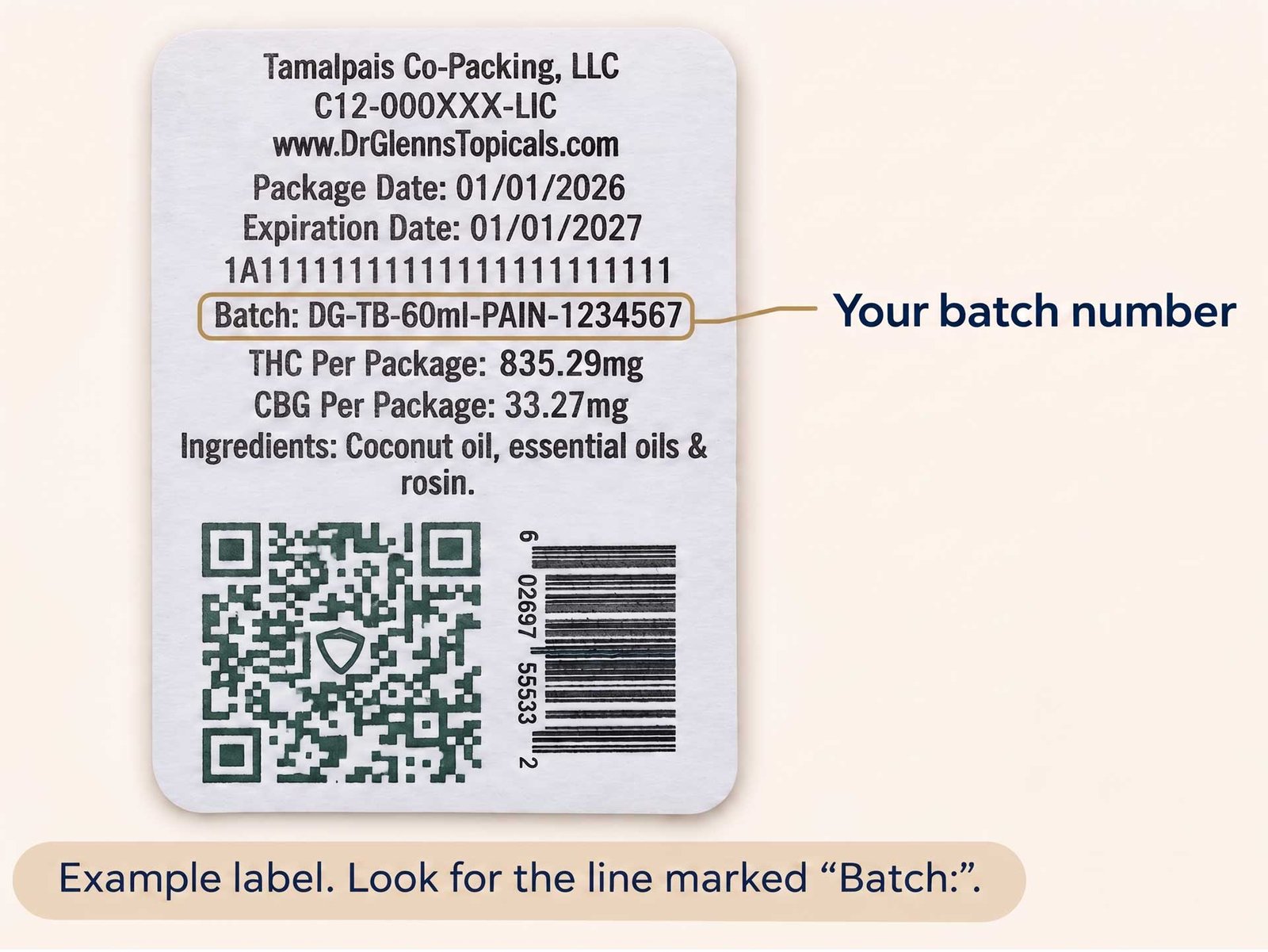
Example label. Your batch number appears beside ‘Batch:’.
Understanding your report.
How to read your COA
You don’t need a science background to understand your results. Start with the product details on the first page, then review the potency and testing summaries.
Where do I find my batch number?
1. Match your product and batch
Check the sample name and batch number against your product. Each report applies to the specific batch identified on the COA.
You will also see the testing laboratory, report date, and a sample ID. The laboratory’s sample ID is different from your product’s batch number.
2. Review cannabinoid potency
The cannabinoid section shows the amounts of THC, CBD, and other cannabinoids measured in the sample.
Total THC
The calculated THC amount, using the formula shown on the report.
Total CBD
The calculated CBD amount.
Total Cannabinoids
The combined calculated amount of cannabinoids included in the laboratory’s total.
Pay attention to the units:
Unit | What it means |
mg/unit | Milligrams in one complete product container |
mg/g | Milligrams per gram of product |
% | Concentration by weight |
For a topical, the amount listed per container is the total in the jar, rather than the amount in one application.
3. Review the testing summary
The first page provides a summary, with detailed results on the following pages. Depending on the product and report, testing may include:
Test | What it checks |
Pesticides | Residues of the pesticides included in the laboratory’s testing panel |
Heavy metals | Arsenic, cadmium, lead, and mercury |
Microbiology | Specified microorganisms, including Salmonella and certain E. coli |
Mycotoxins | Specified toxins produced by certain molds |
Residual solvents | Residues of solvents included in the testing panel |
Foreign material | Visible unwanted material, such as dirt, hair, or insect fragments |
PASS means the reported result meets the applicable limits or specifications for that test.
4. Understand common abbreviations
Term | Meaning |
ND | Not detected at the laboratory’s detection limit. |
NT | Not tested |
LOD | Limit of detection: the lowest amount the method can detect |
LOQ | Limit of quantification: the lowest amount the method can reliably measure |
Action limit | The threshold used to determine whether a result meets the applicable testing requirement |
Need help finding or understanding your results?
Email support@drglennstopicals.com with your product name and batch number. If you’re unsure which number to use, include a clear photo of the label.